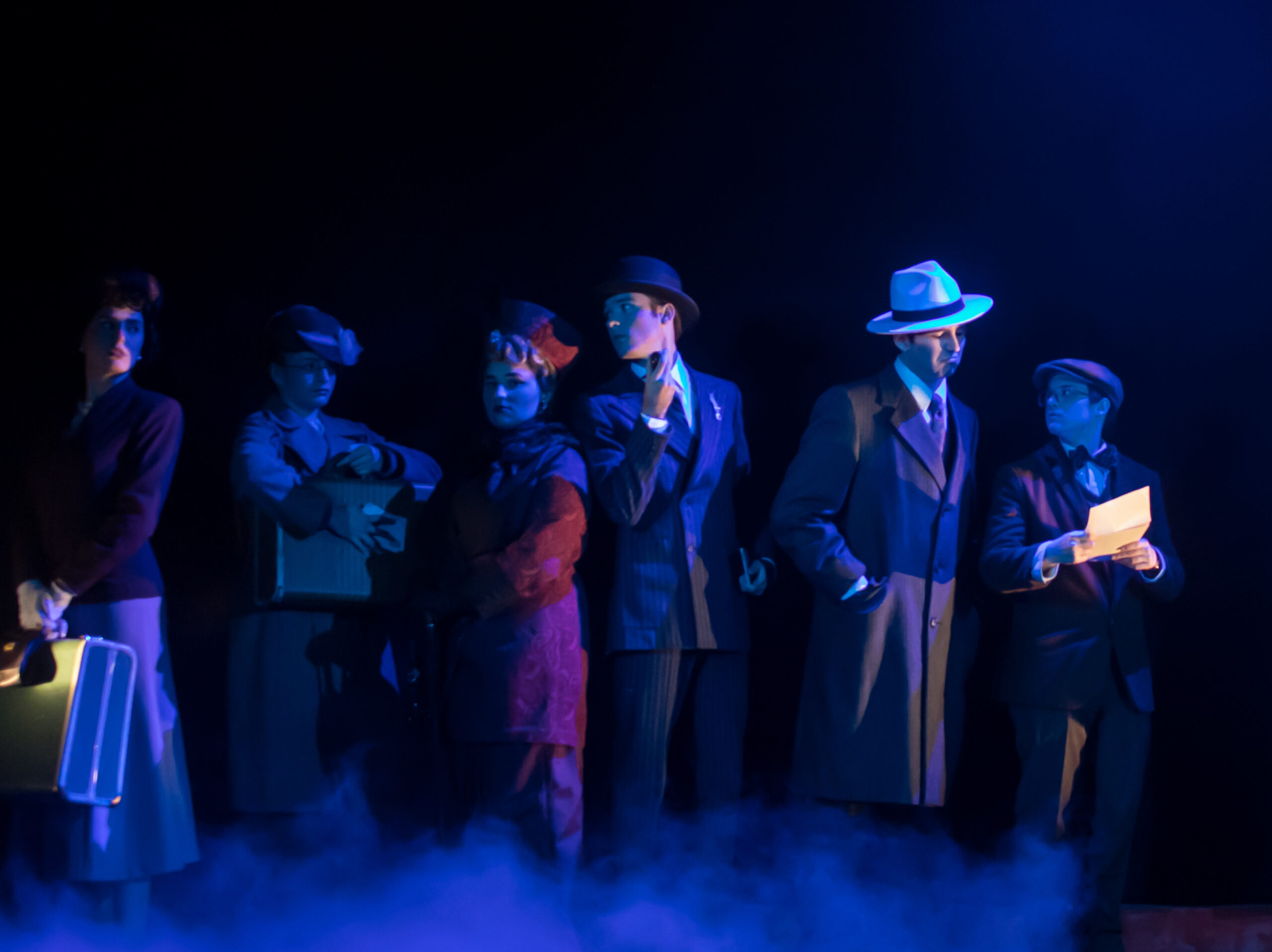
I tried it! We fixed some blocking issues today, giving me opportunities to try things out. Marc had no acting notes for me, which worried me. In my experience, a lack of comments tends to mean that not enough is being provided to warrant comment. Equally so, it’s my job to explore during rehearsals and make myself a better actor, not Marc’s.
I tried to implement the “don’t believe that, believe this” exercise, and found some success. It became more profound in one scene where my attention was fully demanded by my scene partner wailing in agony (fictionally, of course). It was easy to be in the moment during that scene because my ‘targets’ demanded my attention outside of myself, instead of them existing in my head.
The “don’t believe that, believe this” exercise then had a new meaning in my eyes. The statement isn’t about me, it’s about the world around me. The object in front of me is somehow wrong, or not what it needs to be. The “self” isn’t verbalized, which reflects back to what Donnellan says in the book. Juliet doesn’t choose to love Romeo, it is just a fact in her eyes.
All of this is to say that up next, I want to begin removing ideas from my head and placing them outside of myself. I’ve worried that I need to hold onto ideas in my mind in order to react to them at the proper moment, but this completely cuts me off from the world around me. Instead, I want to walk into a space with some thoughts in mind, but ultimately be swept off my feet and driven into the scene by the things around me. “I was going to do this, but Poirot needed to be dealt with.”
None of this is novel, as we’ve explored much of this in prior rehearsals. We continue to place our ideas onto the ‘fourth side’ and try to deliver with intention. Marc has asked us “Are you getting what you want? What change would you see in your partner if you got it?”
In regular life too, I am extremely stuck in my head. I’m conflicted at the moment with the seemingly incompatible ideas of “give them everything you’ve got” and “be in the moment.” When I think of the former, I think of manhandling my performance to provide new and inspiring ideas. When I think of “being in the moment,” I think of… calm. It’s a lack of ideas, or rather, a willingness to let my instincts and preparation lead me to new ideas.
To me, this feels different than “giving it my all” or “trying something new.” To my ears, this means controlling my performance and thinking about how I’ll act. How can I deliberately try something new if I’m just trusting my preparation? Perhaps if I trust my preparation, I’ll find something I never thought of when my partner does something new. Note: There is some difference here when a director asks me to try a new action. Somehow…
I was completely ready to “give it my all” tomorrow and control many aspects of my performance and stay in my head. Now, I am beginning to see that I need to trust myself and stay present with my surroundings to succeed. Tomorrow we’ll be doing a speed-through, so I may only be able to mediocrely test it out, but I have every reason to believe this is a major shift in my mindset about acting in this stage of the process.
Summary: Being in the moment (at this stage of my preparation) will be more fruitful than forcing my performance to be stellar. When directors say “Give me all you’ve got,” I need to let loose by not trying to “give it all I’ve got.”